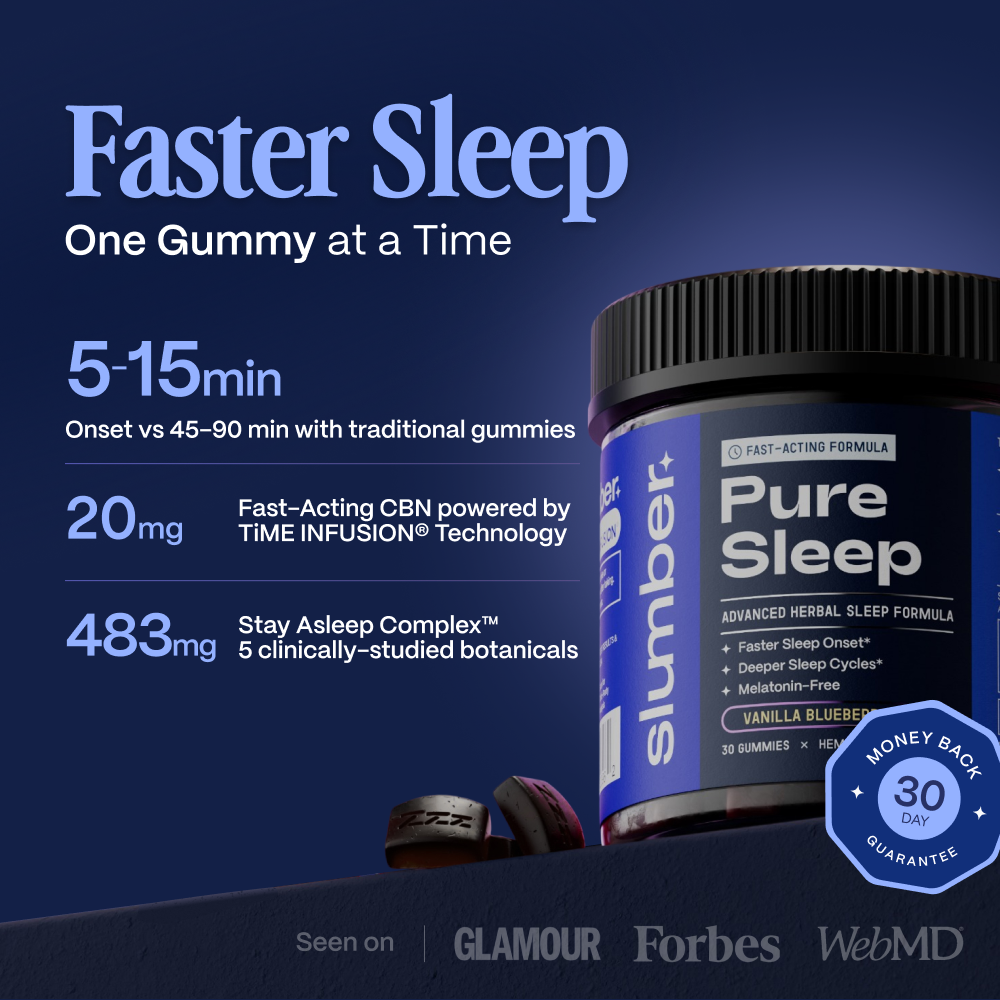
Free shipping on orders $75+ · 30-day money-back guarantee
Free shipping $75+ · 30-day guarantee
Free shipping on orders $75+ · 30-day money-back guarantee
Free shipping $75+ · 30-day guarantee
Before diving into specific studies, it's important to understand why we include research beyond just sleep:

Anxiety & Sleep: Studies show 70% of people with anxiety experience sleep difficulties

Stress & Rest: Chronic stress disrupts natural sleep cycles and recovery

Immune Function: Quality sleep and immune health are bidirectionally linked

Holistic Effects: Cannabinoids interact with multiple body systems simultaneously

CBD is a non-psychoactive cannabinoid extensively studied for anxiety, sleep, pain, and general wellness. Research shows it works through multiple pathways including serotonin receptors, which explains its diverse effects.
Journal of Clinical Sleep Medicine

First objective evidence that CBD works synergistically with terpenes to enhance sleep architecture.
Nutrients

CBD supports both sleep quality and immune function simultaneously, suggesting broad recovery benefits.
Experimental and Clinical Psychopharmacology

Highlighted the need for more rigorous sleep-specific research with standardized CBD formulations.
Anxiety reduction often leads to improved sleep.
Journal of Cannabis Research

Real-world usage shows CBD is used equally for anxiety and sleep, with most people using moderate doses.
The Permanente Journal

CBD's anti-anxiety effects were more consistent than direct sleep effects, suggesting it may improve sleep primarily by addressing underlying anxiety.
Movement Disorders

While CBD didn't eliminate RBD symptoms, it showed transient sleep quality benefits at higher doses.
Journal of Clinical Pharmacy & Therapeutics

Strong preliminary evidence for CBD in RBD symptom management, though larger studies needed.

Slumber's Own CBD & CBN Research
We conducted independent testing to validate the sleep benefits of our proprietary cannabinoid blends.
View Our Research →CBN shows more specific sleep-promoting properties than CBD. Often called "the sleepy cannabinoid," research suggests it works through unique metabolic pathways that directly influence sleep architecture.
Neuropsychopharmacology

Identified active metabolite as potential contributor to CBN's sleep effects, explaining its unique sleep architecture modifications.
Experimental and Clinical Psychopharmacology
First large-scale controlled trial demonstrating CBN's specific benefits for sleep maintenance.
medRxiv preprint

Largest CBN study to date demonstrates clear dose-response relationship with optimal effects at 50mg.
Sleep

High success rate for clinically meaningful sleep improvements with manageable side effects.
Cannabis and Cannabinoid Research
Established the need for rigorous CBN sleep research while acknowledging promising preliminary data.
Frontiers in Molecular Neuroscience

Revealed multiple mechanisms beyond traditional cannabinoid receptors, potentially explaining diverse effects.
Journal of Medicinal Chemistry

Foundational study confirming CBN's preferential CB2 activity and minimal psychoactive properties.
Biomedical & Environmental Mass Spectrometry

Established fundamental pharmacokinetic profile distinguishing CBN from THC.
THC (delta-9-tetrahydrocannabinol) is the primary psychoactive cannabinoid in cannabis and the template for several approved synthetic analogs (such as nabilone and dronabinol). These THC-based medicines have been studied for sleep disturbance, chronic pain, fibromyalgia, and Parkinson's disease, where improvements in sleep often track with better symptom control and quality of life.
American Journal on Addictions

In experienced cannabis users, sustained oral THC was associated with easier sleep initiation and fewer complaints about falling asleep.
(THC Analog) Journal of Clinical Sleep Medicine

This THC-analog improved subjective insomnia more than a standard first-line medication in fibromyalgia-related sleep disturbance.
(THC Analog) Annals of Neurology / NPJ Parkinson's Disease

In Parkinson's disease, a THC-analog improved non-motor symptoms, including patient-reported sleep quality, and maintained these gains during longer-term treatment.
(THC-Containing Medical Cannabis) Rheumatology Clinic Cohort

In real-world rheumatology practice, THC-containing medical cannabis was associated with large perceived gains in both sleep quality and pain control.
(THC-Rich Oils and THC-Based Products) Systematic Review

Across fibromyalgia trials, THC-containing cannabinoid therapies tend to improve both pain and sleep measures, supporting a dual "analgesia + sleep" benefit profile.


The science is advancing rapidly, but key questions remain.
The research paints a nuanced picture: cannabinoids support sleep through multiple pathways. CBD's strength lies in addressing anxiety and stress that disrupts sleep, while CBN appears to work more directly on sleep maintenance and architecture.
Understanding these differences helps explain why some people respond better to one cannabinoid over another — it often depends on the underlying cause of sleep difficulties.